Choosing the right Concealed Hinges can make a cabinet door feel effortless—or leave it rubbing, sagging, or refusing to close. The best choice depends on more than appearance. Door overlay, thickness, weight, opening angle, frame style, and adjustment range all matter. A hinge that looks right in a product photo may still clash with a face frame or sit poorly on a heavy oak door.
Look closely at the cabinet itself. Measure the door and opening, check whether the cabinet is frameless or face-frame, and note how much clearance nearby walls or handles allow. Then compare hinge specifications, mounting plates, soft-close features, and the tools needed for installation. Small details count. A few millimeters can change the reveal between two doors.
A dependable selection rule is simple: “Match the hinge to the door and cabinet before judging the finish.” This is practical guidance, not a quotation attributed to a named expert; no verifiable expert source was provided, so inventing one would be misleading. The sections that follow explain hinge types, measurements, materials, and common selection mistakes. They also consider budget and replacement needs, since a low-cost hinge is not a bargain if it loosens after months of daily use. Expect a little trial and adjustment. Real cabinets are rarely as perfect as diagrams suggest.
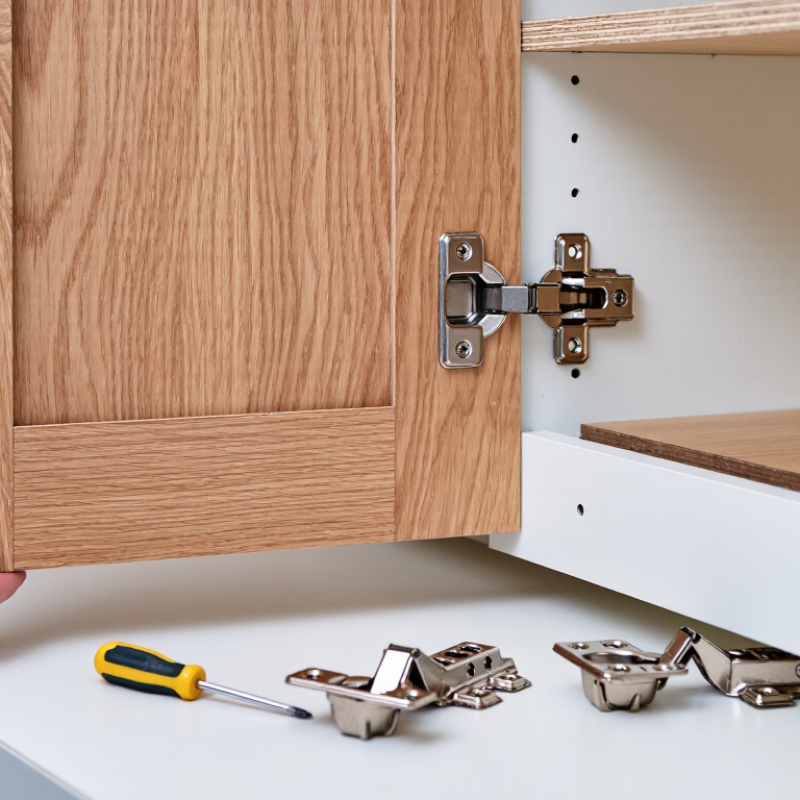
Concealed hinges sit inside a cabinet or door, keeping the hardware out of sight when the door is closed. Their appearance is clean, but the fitting still needs to match the door’s weight, thickness, and opening path. A common type is the cup hinge, often called a European hinge. Its round cup fits into a bored recess in the door, while screws allow adjustment after installation. Full-overlay, half-overlay, and inset describe how the door meets the cabinet—not three different hinge mechanisms. That distinction is easy to miss.
Other options include pivot hinges, which support a door from pivot points, and invisible barrel or knife hinges, which are concealed within the door edge and frame. Pivot designs can suit unusual door sizes, while invisible hinges preserve a traditional, uninterrupted surface. Check the required opening angle and whether adjustment is possible; a door that rubs its frame is a small but stubborn problem. The names are not always used consistently, so verify the fitting diagram before buying. In its 2023 furniture hardware market report, Grand View Research estimated the global market at USD 17.3 billion in 2022 and forecast 5.8% annual growth through 2030. That broad figure signals a substantial hardware sector, but it does not identify which hinge type best suits a particular cabinet. The measurements do.
Begin by identifying what the hinge will support: a room door, a cabinet door, or a compact storage panel. Measure the door’s height, width, and thickness, then note its material and approximate weight. Solid wood and lightweight composite panels place different demands on hinge capacity. Small details matter.
For cabinets, check whether the construction is frameless or uses a face frame. Then determine whether the door is inset, partially overlaying, or fully overlaying the cabinet opening. These positions affect hinge geometry and clearance. A hinge that looks suitable online may not fit the frame or allow the door to close flush. Check the mounting pattern and adjustment range against the cabinet before ordering.
Consider how the door will be used each day. A frequently opened pantry door may benefit from a wider opening angle, while a small vanity door may need only simple, controlled movement. In a humid kitchen or bathroom, confirm that the hinge’s finish and materials suit the environment. For heavier doors, compare the manufacturer’s load rating with the complete door dimensions, not just its thickness. Check the number of hinges required, too. It is easy to overlook nearby walls, handles, or drawers; mock up the swing with tape before drilling. A second measurement can save a frustrating repair.
The best concealed hinge is not simply the strongest one. Match its material to the room and its load rating to the actual door. Steel hinges suit many everyday cabinets, while corrosion-resistant finishes can help in kitchens or laundry areas. In damp spaces, check the maker’s material and finish details rather than relying on appearance alone. A shiny surface does not tell the whole story.
Check the stated load capacity and how it is calculated. Some ratings apply to a pair of hinges, not to each hinge. A wide, solid-wood door puts more strain on its fittings than a small, lightweight panel. Include the weight of attached hardware, and follow the installation instructions. If the door sags after fitting, the problem may be hinge spacing or screw support, not just the rating. Small details matter.
Opening angle affects daily use. A wider angle can help a door clear a nearby wall or reveal a deep cabinet, but it may collide with drawers, handles, or an adjacent door. Measure the space with the door open, not only when it is closed. Also check whether the hinge allows adjustment in multiple directions; that can make alignment easier after installation. I used to treat a larger angle as an automatic upgrade. Not always. A suitable hinge balances material, load, and clearance for that specific cabinet.
Choosing a concealed hinge starts with the door, not the catalog photo. Measure door thickness, overlay, and cabinet opening with a tape; a few millimeters can change the required hinge geometry. For inset doors, check that the door sits flush inside the frame. For overlay doors, measure how much of the cabinet side the door covers. Small details matter. Check the hinge cup diameter and drilling depth against the door, too. A cup that is too deep can break through a thin panel.
Look for separate adjustments for height, side-to-side position, and depth. These help align neighboring doors and correct small gaps after installation. They cannot fix a badly warped cabinet, though. That distinction is easy to miss. Before buying, confirm the hinge’s opening angle and load rating suit the door’s size and weight. A wide door may need more support than a narrow one, even when both look similar.
Installation needs deserve equal attention. Check whether the hinges require a specific cup hole, mounting plate, or screw pattern, and make sure the door has enough clearance to open without hitting a wall or drawer. Use the supplied drilling dimensions, mark the hole carefully, and test the fit before installing every hinge. A cardboard drilling guide can help keep spacing consistent. I would still measure twice; even careful layouts sometimes drift.
Check the dimensions, adjustability, and installation requirements before choosing a hinge.
Typical reference dimensions: many concealed cabinet hinges use a 35 mm cup, about 12 mm cup depth, and a 5 mm drilling distance (K). These are common values, not universal specifications; confirm the hinge maker’s drilling template and your door thickness. Adjustable models often provide roughly 2 mm of movement in some directions, but the range varies. Check door overlay, frame clearance, and mounting-plate compatibility, and drill to the specified depth.
When choosing concealed hinges, match their load rating to the actual door, not just its appearance. A solid, wide cabinet door puts more strain on the hinge than a small, lightweight one. Check the manufacturer’s cycle-test information and corrosion protection, especially for doors near sinks or in humid rooms. A smooth opening matters, but so does a hinge that stays aligned after repeated use.
Price is only part of the cost. Less expensive hinges may work well on lightly used doors, while busy kitchens often benefit from stronger construction and reliable adjustment screws. Paying more for three-way adjustment can make installation easier and help correct a door that begins to sag. Still, the premium option is not automatically the right one. Confirm that its opening angle and mounting plate suit your cabinet.
Long-term maintenance is modest, but not zero. Wipe away dust and cooking residue with a soft, dry cloth, and check screws when a door starts rubbing or closing unevenly. Use lubricant only if the maker recommends it; excess oil can collect grime. A quick inspection twice a year is a reasonable habit, though dusty or damp spaces may need attention more often. This is not a perfect rule. Real wear depends on use, installation, and the door itself.
| Hinge Option | Typical Construction | Durability Considerations | Relative Initial Cost | Long-Term Maintenance | Best Suited For | What to Check Before Buying |
|---|---|---|---|---|---|---|
| Standard concealed hinge | Commonly steel with a protective finish; available in several opening angles and mounting styles. | Usually suitable for everyday cabinet use when correctly sized and installed. Performance depends on the hinge design, finish, door weight, and use frequency. | Low to medium | Periodically check screws, alignment, and smooth movement. Clean with a soft cloth and avoid harsh or abrasive cleaners. | General-purpose kitchen, bathroom, and storage cabinets. | Confirm overlay or inset configuration, cup size, opening angle, door thickness, and the manufacturer’s load guidance. |
| Soft-close concealed hinge | A concealed hinge with an integrated damping mechanism that slows the door near closing. | Adds a moving damper component, so long-term performance depends on mechanism quality and proper adjustment. It can reduce slamming but does not compensate for an overloaded door. | Medium | Keep the damper area clean and adjust the closing force if the model allows it. Replace the hinge if the damper stops working or the door no longer closes reliably. | Frequently used cabinets where quieter, gentler closing is preferred. | Check whether the damper is integrated or separately adjustable, and verify compatibility with the door size and weight. |
| Heavy-duty concealed hinge | Reinforced hinge design intended for larger or heavier cabinet doors; materials and construction vary by model. | Can provide added support when selected to match the door and installed with suitable fasteners. “Heavy-duty” is not a universal rating, so compare stated load limits and test information. | Medium to high | Inspect mounting screws and door alignment periodically, especially on large or frequently used doors. Follow the maker’s adjustment and cleaning instructions. | Tall pantry doors, wide cabinet fronts, or other doors with greater support requirements. | Use the specified number of hinges and confirm the rated door dimensions, weight, mounting requirements, and substrate strength. |
| Stainless-steel concealed hinge | Made with stainless steel components; exact alloy and corrosion resistance differ between products. | Stainless steel is generally chosen for improved corrosion resistance compared with ordinary unprotected steel, but it is not immune to corrosion in every environment. | Medium to high | Wipe away moisture, dirt, and residue. Avoid chlorine-based cleaners and abrasive tools; check the product’s care guidance for its specific finish and alloy. | Humid areas or settings where corrosion resistance is an important selection factor. | Verify the stated material or grade, finish, intended environment, and compatibility with nearby metals and cleaning products. |
| Compact or limited-opening concealed hinge | Space-saving or geometry-specific design, sometimes with a restricted opening angle. | Useful where clearance is limited, but suitability depends on the cabinet layout and door movement. A restricted opening angle may not suit every storage need. | Low to medium | Check alignment and clearance after installation. Keep the hinge area free of dust and make adjustments according to the product instructions. | Compact cabinets, corner layouts, or installations with nearby walls or fittings. | Confirm opening angle, clearance, mounting pattern, and whether the door can open far enough for practical access. |
Cost guide: Relative cost is a general comparison, not a quoted market price; actual prices vary by material, design, quantity, and region. For a reliable choice, match the hinge to the door’s dimensions and weight, cabinet construction, opening requirements, and installation conditions.
Measure the door’s height, width, and thickness. Note its material and approximate weight.
Yes. Inset, partial-overlay, and full-overlay doors need different hinge geometry. Check the mounting pattern and clearance.
Compare its load rating with the complete door’s dimensions and weight. Check whether the rating applies to one hinge or a pair.
Check the stated material and corrosion-resistant finish. A shiny surface alone tells you little.
No. It may help reveal a deep cabinet, but the door could hit a drawer or nearby wall. Measure the open swing.
Check the hinge’s adjustment range and screw support. Use tape to mock up the swing before drilling. It can save a repair.
Wipe away dust and cooking residue with a soft, dry cloth. Check screws if the door rubs or closes unevenly.
Twice a year is a reasonable starting point. Damp or dusty rooms may need more attention. Real wear varies.
Choosing the best Concealed Hinges starts with understanding the main hinge types and how each is suited to different doors, cabinets, and applications. Consider the door’s size, weight, thickness, and intended use, then compare hinge materials, load capacity, and opening angles to find an option that provides suitable support and movement.
Before making a choice, check the hinge dimensions, available adjustment features, and installation requirements to ensure a proper fit and smooth setup. Also weigh durability against upfront cost: a well-matched hinge can reduce wear, simplify future adjustments, and limit maintenance over time. By assessing these factors together, you can select hinges that meet your practical needs and provide reliable performance.

Send model numbers, drawings or target specs — an export specialist replies within 24 hours.